Table of Contents
ToggleMiele dishwashers occupy a unique corner of the appliance market, they’re built like commercial equipment but designed for residential kitchens. If you’re considering one for your home, you’re likely weighing premium performance against a significant upfront investment. Unlike budget models that require replacement every seven years, Miele units are engineered for two-decade lifespans, with components tested to 10,000 cycles. This guide walks through what makes these machines different, which models deliver the best value in 2026, and what homeowners should expect during installation and ongoing maintenance. Whether you’re renovating a kitchen or simply replacing a failing unit, understanding Miele’s approach to dishwashing will help you decide if the investment aligns with your needs.
Key Takeaways
- Miele dishwashers are engineered for 20-year lifespans with industrial-grade components tested to 10,000 cycles, delivering durability that justifies the premium price when compared to budget models requiring replacement every 7 years.
- Top 2026 models like the G 7316 SCU and G 5006 SCU offer distinct features—AutoDos detergent dispensing, QuickIntenseWash, and handleless operation—making a Miele integrated dishwasher suitable for various kitchen styles and budgets.
- Water efficiency of 2.5-3.5 gallons per cycle combined with 20-year use results in hundreds of dollars in utility savings, plus proprietary features like Perfect GlassCare protect delicate items and reduce long-term replacement costs.
- Proper installation requires precise drain hose routing, water softener calibration, and leveling—professional setup ensures you avoid fault codes and maximize the dishwasher’s performance from day one.
- Monthly maintenance like filter cleaning and quarterly vinegar cycles keep your Miele dishwasher running flawlessly, while OEM parts availability for decades-old models ensures long-term serviceability.
- Miele’s total cost of ownership over 20 years beats buying multiple mid-tier dishwashers, outperforming Bosch on longevity and Gaggenau on value, making it the top choice for homeowners prioritizing reliability.
Why Miele Dishwashers Stand Out in the Premium Appliance Market
Miele’s reputation hinges on industrial-grade engineering adapted for home use. The company tests each dishwasher model to the equivalent of 20 years of typical household use before it leaves the factory, a standard most competitors don’t match.
Build quality starts with stainless steel tubs and heavy-duty hinges rated for over 10,000 open-close cycles. The door seal alone is designed to maintain integrity for decades, not just the warranty period. Internal spray arms use precision-machined nozzles that deliver consistent water pressure across all rack levels, ensuring even coverage on every load.
Noise levels sit around 38-45 dBA depending on the model, quieter than most refrigerators. This matters if your kitchen opens to living spaces or if you run loads overnight. The sound dampening comes from triple-insulated tub walls and brushless motors that eliminate the grinding noise common in cheaper machines.
Energy efficiency is where Miele justifies part of its price tag. Most 2026 models use 2.5-3.5 gallons per cycle, roughly half what older dishwashers consume. Over a 20-year lifespan, that adds up to thousands of gallons and hundreds of dollars in utility savings, especially in regions with high water and sewer rates.
The company also manufactures most components in-house at German facilities, which means replacement parts remain available long after other brands discontinue support for older models. If a circulation pump fails in year 15, you can still get OEM parts without hunting salvage yards or aftermarket suppliers.
Top Miele Dishwasher Models for Homeowners in 2026
Miele’s 2026 lineup includes over a dozen models, but a few stand out for residential use. Homeowners should focus on the G 7000 series for versatile performance and the G 5000 series for budget-conscious buyers who still want core Miele benefits.
The G 7316 SCU AutoDos leads the pack with integrated detergent dispensing, the machine stores liquid detergent and auto-doses based on soil sensors. This eliminates guesswork and reduces waste. It holds 14 place settings, includes a third cutlery tray, and features Miele’s Knock2Open technology for handleless cabinet integration. Cleaning experts have rated this model highly for both drying performance and reliability, particularly on challenging loads.
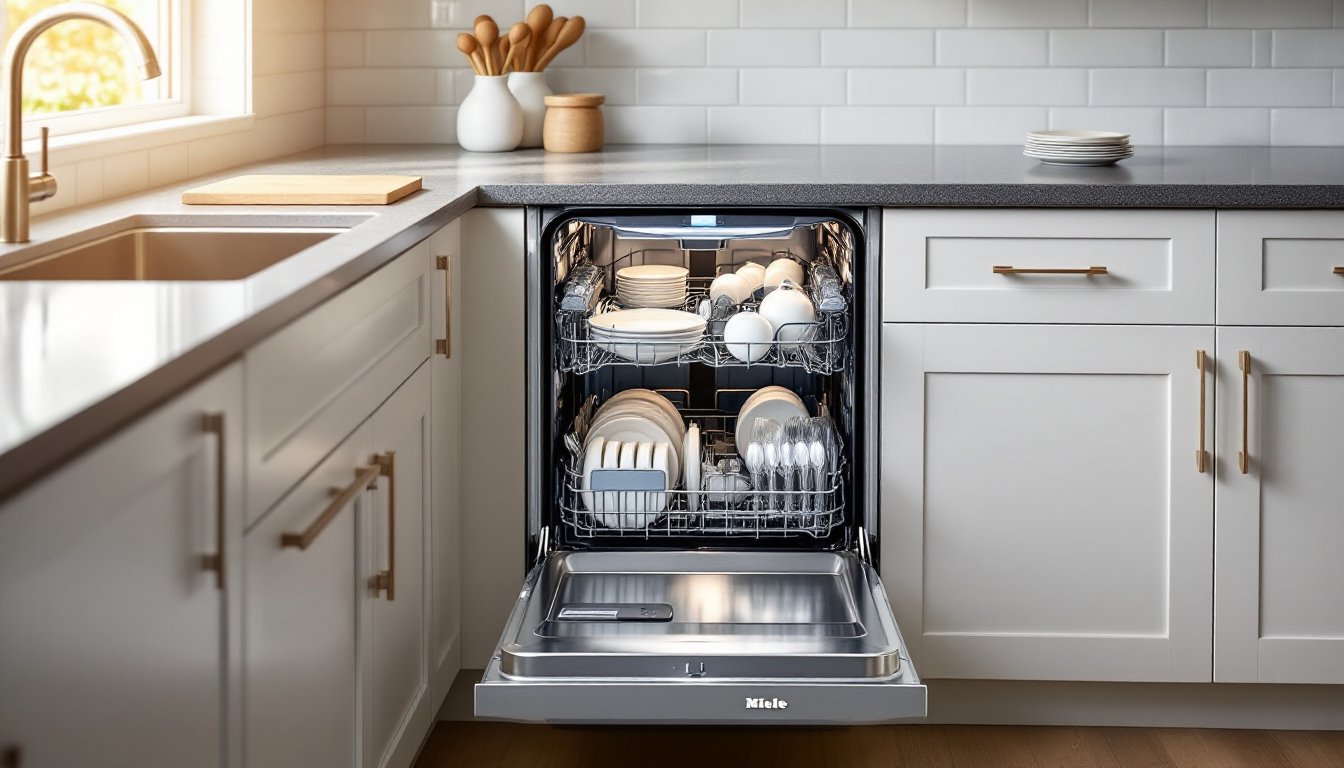
For integrated installations, the G 7366 SCVi offers full panel-ready design with AutoOpen drying, the door automatically pops open at cycle end to release steam, drastically improving drying results on plastics. This model fits standard 24-inch openings and works well in custom cabinetry where a seamless look is essential.
The G 5006 SCU delivers Miele’s core cleaning technology at a lower entry price. It skips AutoDos and WiFi connectivity but retains the stainless steel tub, quiet operation, and 20-year test rating. If you don’t need smart features and prefer to dose detergent manually, this model offers excellent value.
For compact kitchens, the G 5481 SCVi is an 18-inch miele integrated dishwasher that holds 9 place settings. It’s ideal for condos, ADUs, or galley kitchens where a full-size unit won’t fit. Even though the smaller footprint, it uses the same spray arm technology and offers similar wash performance to larger siblings.
Key Features That Make Miele Dishwashers Worth the Investment
Several Miele-specific technologies separate these machines from standard dishwashers, justifying the premium price for homeowners who prioritize performance and longevity.
AutoDos liquid detergent dispensing calculates the exact amount needed per load based on soil sensors. The internal reservoir holds enough detergent for roughly 20 cycles, and the machine prompts you when it’s time to refill. This reduces detergent waste by up to 30% compared to manual dosing and ensures optimal cleaning chemistry every time.
3D MultiFlex tray systems replace traditional utensil baskets with a shallow top tray that accommodates flatware, small bowls, and utensils. This frees up space in the lower rack for larger items like skillets and baking sheets. The tray adjusts in height and can be removed entirely if you need to fit tall items like stock pots.
QuickIntenseWash completes a full wash and dry cycle in under an hour without sacrificing cleaning power. It uses higher water temperature and increased spray pressure, making it practical for homeowners who need clean dishes before guests arrive or between meal prep sessions.
Knock2Open allows handleless operation, tap the cabinet front twice, and the door springs open. This works with flush-mount installations where traditional handles would disrupt clean cabinet lines. It’s particularly useful in modern kitchens where minimalist design drives appliance choices.
WiFi connectivity (on select models) lets you monitor cycle progress, receive maintenance alerts, and download specialty wash programs via the Miele app. While not essential, it’s handy for tracking energy use or troubleshooting issues before calling service.
All models include Perfect GlassCare technology that adjusts water hardness and temperature to protect delicate glassware from etching. If you hand-wash wine glasses out of fear, this feature alone might justify the upgrade.
Installation and Setup: What to Expect with Your Miele Dishwasher
Miele dishwashers fit standard 24-inch cabinet openings (or 18-inch for compact models), but installation differs slightly from budget brands. Plan for professional installation unless you’re comfortable with plumbing and electrical work.
Rough-in requirements include a 120V grounded outlet under the sink or in an adjacent cabinet, Miele units don’t use hardwired connections. You’ll need a 3/8-inch compression fitting on the hot water supply line and a drain connection with an air gap or high loop to prevent backflow. Check local codes: some jurisdictions require air gaps on all dishwashers.
The drain hose routing matters more than with other brands. Miele’s drain pump is designed for specific hose elevations, too much slack or a drain loop positioned incorrectly can cause drainage errors. Follow the installation manual’s diagrams precisely, or you’ll trigger fault codes.
For integrated installations (cabinet panel attached to the door), you’ll mount a custom panel using the included bracket kit. The panel shouldn’t exceed 10 lbs for most models, heavier panels can stress the hinges over time. Use 1/2-inch or 3/4-inch plywood or MDF, not particleboard, which can warp from steam exposure.
Leveling is critical. Miele dishwashers use front-leg adjusters and rear roller assemblies. Get all four corners plumb, an unlevel machine will leak from the door seal or fail to drain completely. Use a 4-foot level across the front and side-to-side.
First-time setup includes a water softener calibration based on your local water hardness (measured in grains per gallon or ppm). You’ll add dishwasher salt to a reservoir in the tub floor, this is separate from detergent and regenerates the built-in ion exchanger. Don’t skip this step, even if you have a whole-house water softener: the dishwasher’s system is optimized for glassware protection.
Most installations take 2-3 hours for a professional, longer for DIYers unfamiliar with the brand. If you’re replacing an existing dishwasher, verify that the new unit’s depth and height match, Miele units run slightly deeper than some brands, which can affect countertop overhang clearance.
Maintenance Tips to Keep Your Miele Dishwasher Running Flawlessly
Routine maintenance on a Miele dishwasher is minimal, but a few tasks ensure you get the full 20-year lifespan the company engineers for.
Monthly tasks:
- Check and clean the triple filter system at the tub bottom. Twist the coarse filter counterclockwise, lift out the fine mesh filter, and rinse under running water. Food debris here reduces spray arm pressure and can cause cloudy glassware.
- Inspect spray arm nozzles for mineral buildup. If you have hard water, soak the arms in white vinegar overnight every few months.
- Refill dishwasher salt if the indicator light appears. Use only salt labeled for dishwashers, table salt contains anti-caking agents that damage the ion exchanger.
Quarterly tasks:
- Run a cleaning cycle with Miele dishwasher cleaner or white vinegar (2 cups in the bottom of an empty tub). This dissolves mineral deposits in the heating element and internal plumbing.
- Wipe down the door gasket with a damp cloth. Crumbs and grease can compromise the seal over time.
Annual tasks:
- Check the drain hose connection under the sink for leaks or kinks.
- Inspect the inlet valve screen (where the water supply line connects) for sediment. Turn off the water supply, disconnect the line, and remove the small mesh screen with needle-nose pliers. Rinse and reinstall.
What NOT to do:
- Don’t use rinse aid formulated for other brands. Miele’s rinse aid is calibrated for their drying systems: generic products can leave residue.
- Avoid running the garbage disposal while the dishwasher operates. Shared drain lines can cause backpressure that triggers error codes.
- Don’t overload racks. Blocking spray arm rotation is the most common cause of poor cleaning performance.
If a fault code appears, consult the manual before calling service, many codes (like F11 for slow drainage) are user-fixable by clearing the filter or adjusting the drain hose. For issues requiring parts replacement, use only OEM Miele components. Aftermarket pumps and valves rarely meet the same durability standards.
Comparing Miele to Other Premium Dishwasher Brands
Miele competes with Bosch, Thermador, and Gaggenau in the premium dishwasher segment. Each brand has strengths, but Miele’s focus on longevity and serviceability sets it apart.
Miele vs. Bosch: Bosch offers quieter operation in some models (down to 38 dBA) and costs 15-20% less on average. But, Bosch units are typically tested to 10 years, not 20. Miele’s AutoDos and AutoOpen drying are proprietary features Bosch doesn’t match. If upfront cost is the priority, Bosch delivers excellent value. If you plan to stay in your home long-term, Miele’s extended lifespan tilts the value equation.
Miele vs. Thermador: Thermador (a Bosch subsidiary) targets the luxury market with features like StarDry and custom panel options. Cleaning performance is comparable, but Thermador’s serviceability lags, parts availability drops off after 10 years. Miele maintains parts inventory for models decades old. Thermador wins on aesthetics for ultra-high-end kitchens: Miele wins on long-term cost of ownership.
Miele vs. Gaggenau: Gaggenau dishwashers are often twice the price of Miele for marginal performance gains. They’re built for design-first kitchens where appliances must disappear entirely. Unless you’re working with a designer who specifies Gaggenau for aesthetic reasons, Miele offers 90% of the performance at half the cost.
For homeowners browsing appliance reviews and kitchen organization ideas, Miele consistently ranks highest for reliability and owner satisfaction. The brand’s service network is also more robust in North America than European competitors, which matters when you need warranty work or parts in year 12.
The real comparison isn’t Miele versus other premium brands, it’s Miele versus buying two or three mid-tier dishwashers over the same 20-year period. Total cost of ownership favors Miele if you account for replacement costs, disposal fees, and the hassle of reinstallation.
Conclusion
Miele dishwashers aren’t impulse purchases, they’re calculated investments for homeowners who value durability and performance over short-term savings. The upfront premium buys you 20-year engineering, quieter operation, and features like AutoDos and AutoOpen that reduce long-term costs and hassle. Installation requires attention to detail, but maintenance is straightforward if you stay on top of filter cleaning and salt refills. For kitchens where appliances need to last as long as the cabinetry, Miele delivers returns that cheaper alternatives simply can’t match.